Biomimetic Code: Learning from Mycelium and Cellular Automata to Build Resilient Networks

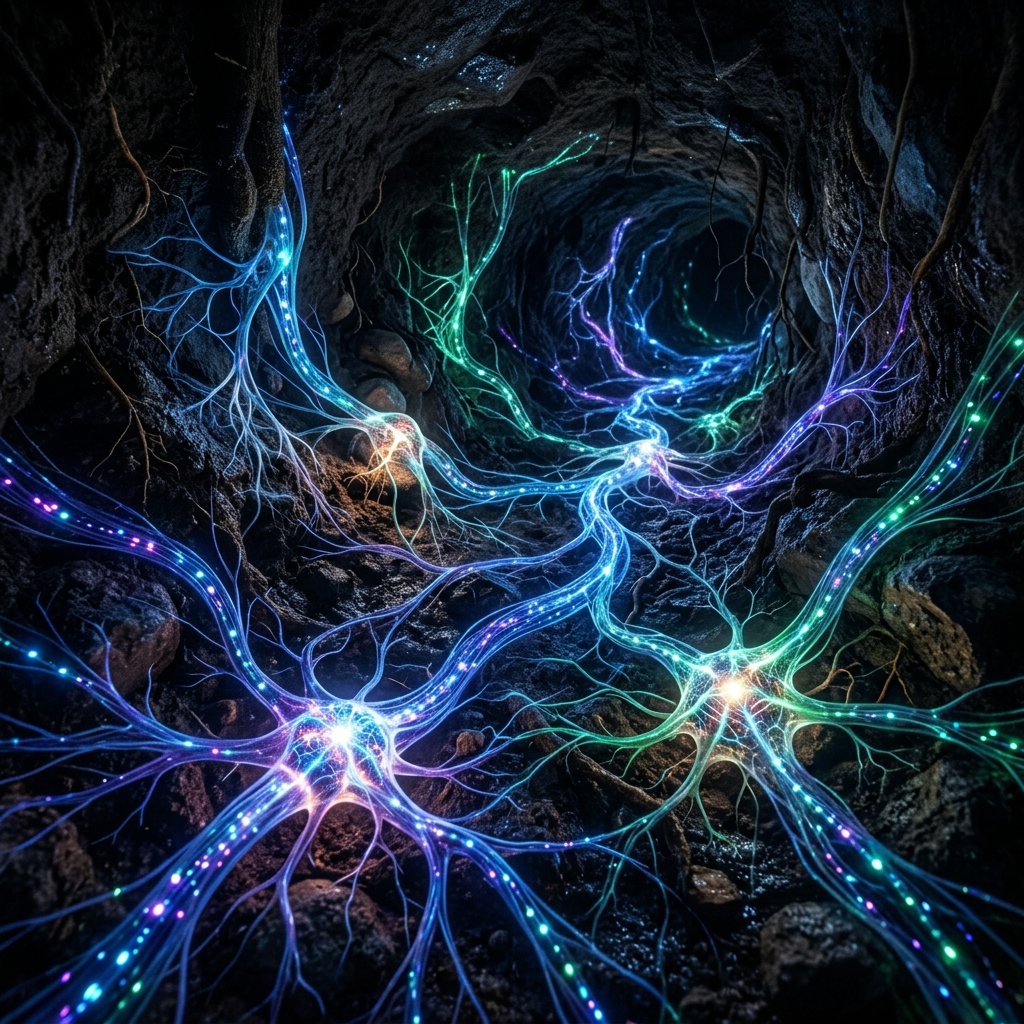
Table of Contents
Our digital world is incredibly fragile. We live under the illusion of bulletproof connectivity. Yet, a single DNS routing error or an undersea cable cut drops entire economies. Payment gateways fail, hospitals freeze, and supply chains break. It happens in seconds.
This fragility stems from our design philosophy. We build networks like hierarchical trees. There is a root, branches, and leaves. Cut a branch, and every leaf on it dies.
We must abandon this top-down architecture. To survive the next century, software networks must study biological systems. They are the oldest network engineers on Earth.
At JULZ, founded in Kenya in 2016, our sandbox is Ajulu Labs. We study mycelial networks and cellular automata to write software that is decentralized, self-healing, and resilient.
The Wisdom of the Mycelial Grid
Under the soil of a healthy forest, mycelium fungal threads connect every plant. This is a resource-sharing highway. It has no central router and no database server. Yet, it manages nutrients across miles of forest floor.
It works through simple local rules:
First, local-first growth. Fungal threads grow toward nutrients based on local environmental signals. They do not request instructions from a central system. Each node operates independently, processing local context.
Second, distributed redundancy. Mycelial grids form hyper-connected meshes. If you dig a trench and cut through a section of the grid, the network does not crash. Fungal threads automatically reroute nutrients around the severed area using adjacent pathways. The network survives intact, healing itself dynamically.
Third, dynamic resource allocation. Fungi act as ecological brokers. They transfer excess carbon from trees located in sunny patches to younger saplings growing in the shade. Resources are balanced across the entire system.
When we translate these mycelial patterns into software engineering, we move away from client-server hubs. We design peer-to-peer data syncing protocols. Your device syncs data directly with nearby devices. There is no central server intermediary. The mesh network coordinates local communication, keeping municipal grids, clinical logs, and market registries running even during global outages.
Emergent Logic: Cellular Automata in Design
In addition to fungal grids, we study Cellular Automata. These are model systems consisting of a grid of cells. Each cell updates its state based on a set of simple, local rules. John Conway’s Game of Life is the most famous example.
Cellular automata demonstrate how complex, highly organized, and lifelike patterns can emerge from simple, local interactions.
At Aju Studio, we use cellular automata algorithms to optimize signal routing on custom circuit boards. We can also grow structural designs that replicate leaf veins or bone structures. These biomorphic patterns distribute mechanical load dynamically. They are lighter, stronger, and adapt to stress, requiring up to 40% less raw material than standard geometric shapes.

Crafting Enduring Systems
Our commitment to biomimicry is not just a scientific interest: it is a moral responsibility. We build systems that protect and empower. We reject the short-term monetization pressure that forces software teams to release rushed, insecure platforms.
By routing our projects through The Hold, we secure our R&D breakthroughs. This allows us to focus on long-term stability and security. Nature does not rush. It builds slowly, adapts constantly, and endures across eras. Let us stop coding like mechanics, and start forging like ecologists.