The Sovereign Cyberdeck: Prototyping the Decentralized AI Mesh Node

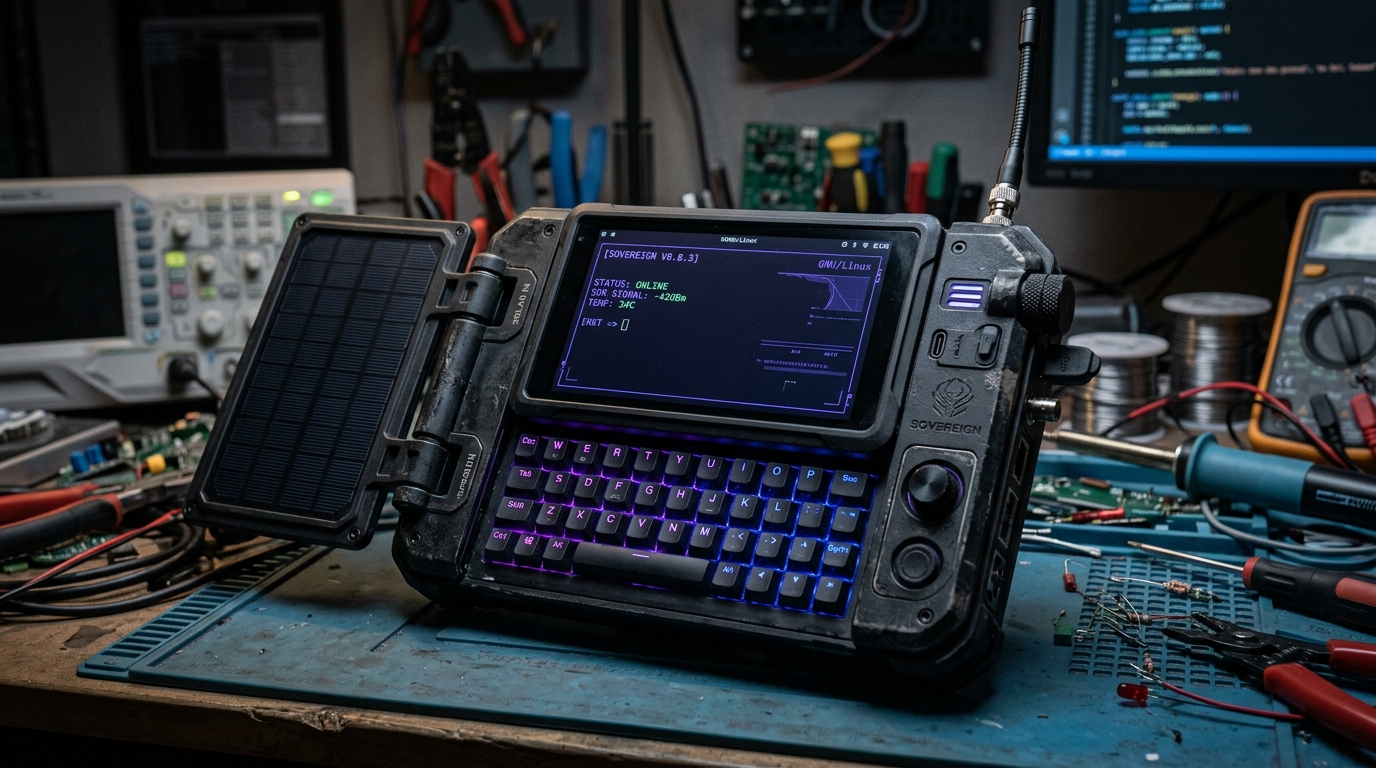
Table of Contents
The Obsolescence Trap
For the last two decades, consumer electronics have evolved toward a singular design pattern: the sealed black glass enclosure. Modern smartphones and laptops are built as rent-seeking gateways rather than personal property. They are held together by industrial adhesives, protected by proprietary software locks, and designed to tether our digital lives directly to centralized cloud servers. If the internet goes down, or if a corporate API changes, our expensive computing hardware turns into electronic waste.
This model does not represent ownership; it represents a lease on digital existence.
To break this loop, I have been brainstorming and designing an alternative path: the Sovereign Cyberdeck (Mk II). This is a blueprint for a pocket-sized, modular, and repairable field terminal that acts as a personal workstation, an independent communication lifeline, and a node in a planetary decentralized computer mesh. It is designed to bridge the physical and digital, the modern and the traditional, creating a resilient technical artifact built to last.
The Physical Architecture: Modular, Repairable, and Biophilic
A sovereign terminal must survive in the field, which requires moving away from fragile aesthetics.
The physical configuration I am prototyping features a rugged, weather-sealed 6.5-inch touchscreen mounted on a sliding chassis. When slid upward in landscape mode, it reveals a compact, tactile mechanical QWERTY keyboard with custom-backlit keys, reminiscent of vintage sliding phones but engineered with modern mechanical switches.
+-----------------------------------+
|        6.5" Touchscreen Display   |  <-- Slides upward in landscape
+-----------------------------------+
| [Q][W][E][R][T][Y]... mechanical  |  <-- Revealed sliding keyboard
+-----------------------------------+
True to our biophilic design philosophy, the chassis rejects cheap virgin plastics and toxic manufacturing methods. Instead, the framework is built using a recycled magnesium-aluminum alloy wrapped in tactile mycelium-leather grips and sustainable, pressed organic hemp fibers. This combination gives the device a warm, organic feel while remaining structural and drop-resistant.
To solve the heat generation of running local artificial intelligence without power-hungry, noisy fans, the backplate utilizes a passive thermal cooling system. The internal heat-pipes route warmth to an exterior heat sink shaped in fractal patterns mimicking leaf veins and termite mound ventilation structures. This passive design maximizes surface area and air flow, keeping the processor cool silently.
Decentralized AI: The VRAM Mesh Marketplace
Running modern artificial intelligence requires massive amounts of GPU VRAM (video memory). Portable, battery-powered devices simply cannot pack the necessary hardware inside a pocket-sized form factor without draining their batteries in minutes.
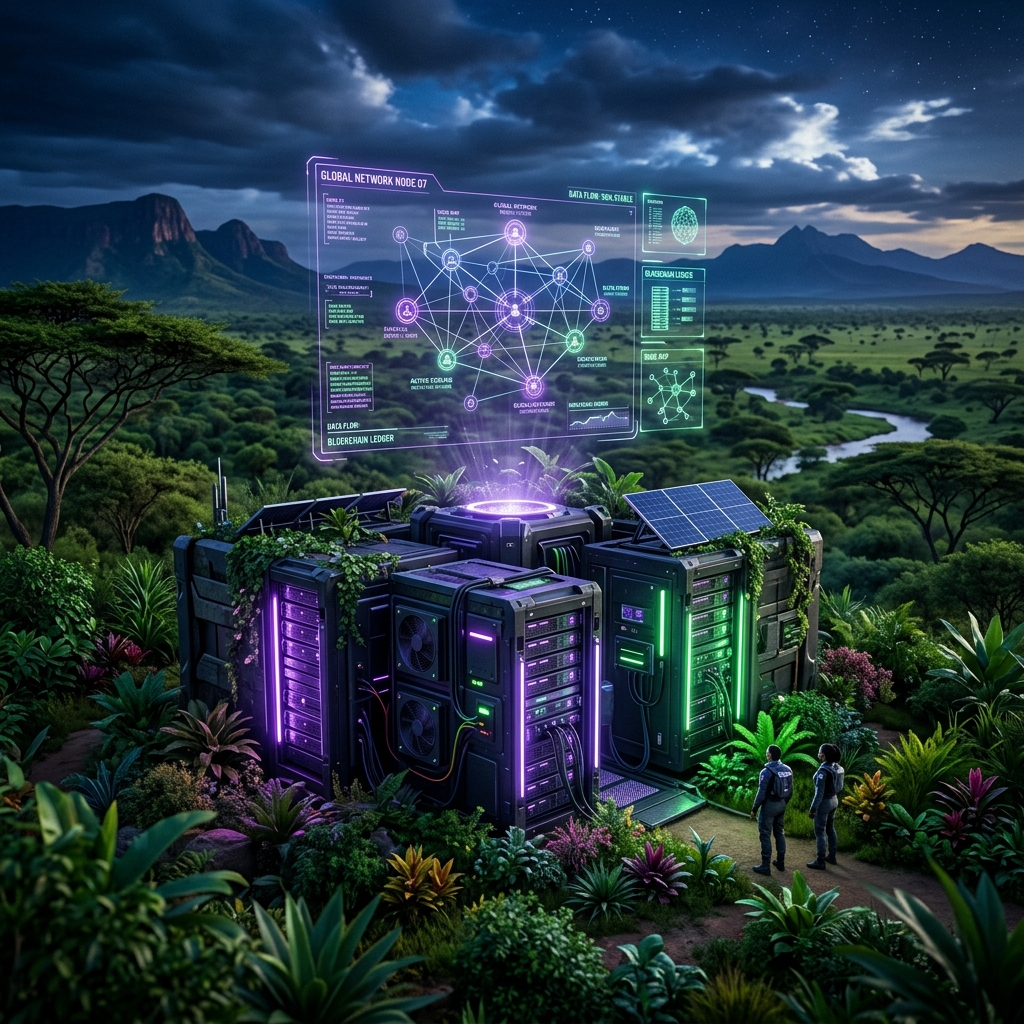
My solution is to establish an ad-hoc decentralized VRAM clustering marketplace that operates over local mesh connections.
Under this setup, the cyberdeck implements a dynamic LLM Routing Policy:
- Level 1 (Local): Small, voice-command tasks and basic text translations run locally on the device’s internal neural processing unit (NPU) using a lightweight 1B parameter model.
- Level 2 (Local Cluster): Medium tasks, like document summarization or layout rendering, are distributed over a temporary Wi-Fi mesh of 3 to 4 nearby cyberdecks.
- Level 3 (Global Mesh): Heavy tasks, like deep reasoning or image synthesis, broadcast a resource query to the wider mesh.
       [Your Cyberdeck] (Initiates heavy AI task)
              |
              | (LoRa query: "Need 24GB VRAM")
              v
     +-----------------+-----------------+
     |                 |                 |
     v                 v                 v
[Node A (8GB)]   [Node B (8GB)]   [Node C (8GB)]  <-- Secure Peer-to-Peer Cluster
     |                 |                 |
     +-----------------+-----------------+
              | (Encrypted computation)
              v
       [Your Cyberdeck] (Receives completed payload)
When a Level 3 task is initiated, the cyberdeck queries the mesh for available VRAM nodes. Nearby devices with idle compute power allocate a portion of their GPU memory to form a temporary, encrypted cluster. The task is split, computed in parallel, and returned to your device.
The entire transaction is settled automatically through tokenless smart contracts. The user pays only for the exact resources utilized (calculated in VRAM-seconds and FLOPs), and the earnings are transferred directly to the wallets of the contributing node owners.
Addressing the Latency and Trust Challenges
Decentralized clustering over wireless networks introduces two major hurdles: network latency and hardware trust.
Latency Mitigation
Splitting AI model weights across physical devices over wireless links can introduce communication bottlenecks. To mitigate this, the cyberdeck utilizes matrix slicing algorithms and weight compression protocols. Instead of transferring raw weights during execution, the system shares pre-computed attention activations over high-speed local Wi-Fi or 5G bursts. The slow LoRa signaling layer is reserved solely for coordinating the cluster and routing control packets, leaving high-bandwidth channels clear for rapid payload exchanges.
Zero-Trust Verification
How do you trust that a borrowed computing node isn’t reading your sensitive prompts or returning poisoned results?
To protect user privacy and computation integrity, the clustering protocol runs calculations inside Trusted Execution Environments (TEEs) on the host hardware. Furthermore, the system implements Zero-Knowledge Proofs (ZKPs) and cryptographic verification. Lenders must submit a mathematical proof showing that the computation was executed correctly without access to the decrypted raw input data, ensuring absolute confidentiality.
⚡ Field Update: NVIDIA PAIR and the Dawn of Local AI Clusters
The thesis of pooling idle silicon across personal devices is no longer a distant thought experiment. In a major validation of this architectural direction, NVIDIA released the beta of its Personal AI Router (PAIR): a software layer engineered to create private, local AI inference clusters across existing personal hardware.
Instead of requiring enterprise server racks, specialized high-speed interconnect cabling, or elaborate cluster orchestration scripts, PAIR operates directly on the local network. It automatically discovers compatible machines across your subnet: linking together RTX desktop workstations, DGX development rigs, and Apple Silicon Macs already powered on in your workspace. Idle compute is harvested dynamically without manual reconfiguration.
   [Sovereign Cyberdeck / Client Terminal]
                     |
                     | (Single unified OpenAI-compatible endpoint)
                     v
       +----------------------------+
       |   NVIDIA PAIR (Subnet)     |  <-- Automatic node discovery & workload routing
       +----------------------------+
            |              |             |
            v              v             v
      [RTX 4090 PC]   [DGX Station]  [M-Series Mac]
      (Ollama node)   (TensorRT-LLM) (LM Studio node)
Architecturally, PAIR supports familiar, open backends such as Ollama and LM Studio. It presents client applications with a single consolidated endpoint for inference. Your local applications, custom scripts, and cyberdeck terminals send requests to one address, while the router balances the computational burden across whatever silicon is idle on your local wire.
Most importantly, privacy remains uncompromisingly local. Prompts, documents, system files, and autonomous agent contexts never transit an external commercial cloud; they stay strictly inside your physical perimeter.
This marks a decisive step toward the modular, distributed AI topology we outlined above. While our long-term cyberdeck research pushes further into carrier-free wireless LoRa coordination and cryptographic micro-settlements, developments like PAIR prove that the industry is converging on local-first distributed compute: personal devices pooling nearby resources to run sovereign intelligence without cloud gatekeepers.
Field Source: Review NVIDIA’s beta architecture at NVIDIA Personal AI Router (PAIR).
LoRa, SDR, and the Sensory Layer
True self-reliance requires communication channels that remain open when the cellular grid fails. The cyberdeck operates on a resilient communication stack:
- LoRa Mesh Radio: Operating on unlicensed sub-gigahertz bands, the built-in LoRa radio enables encrypted peer-to-peer messaging over miles, completely bypassing commercial cellular networks and ISPs. Each cyberdeck acts as a repeater, automatically routing packets across multiple hops to extend the network’s reach.
- Modular SDR (Software Defined Radio): Via standardized expansion ports on the side of the chassis, users can attach a modular SDR module. This hardware add-on allows the deck to scan radio spectrum frequencies, capture weather satellite telemetry, monitor marine AIS signals, and communicate over amateur bands. The software driver and control GUI install seamlessly upon attachment.
- Contextual AI Camera: The cyberdeck includes an AI-powered camera designed for physical spectrum interpretation. It automatically performs real-time optical character recognition (OCR) and scene-understanding—allowing users to scan schematics, analyze structural components, or identify local biological resources in the field.
- Hands-Free voice prompting: Using a local, offline voice recognition engine, users can interface with their terminal hands-free. A researcher can query the mesh, adjust SDR frequencies, or prompt the AI cluster simply by speaking, allowing them to keep their hands on their tools.
The Micro-Internet: Self-Hosted Intranets
The ultimate expression of digital sovereignty is the ability to host your own infrastructure. Every Sovereign Cyberdeck functions as a self-contained web server capable of hosting websites, web applications, and local databases.
By utilizing IPFS (InterPlanetary File System), files and web assets are stored and distributed peer-to-peer across the cyberdeck mesh. If one node goes offline, the website remains accessible because other nodes in the mesh hold encrypted, cached fragments of the data.
This ad-hoc intranet supports local barter economies, forums, and decentralized messaging boards. Furthermore, it enables mesh-native multiplayer games. Because these games are hosted directly across the peer-to-peer network, they run with zero central server dependencies, utilizing the same underlying cryptocurrency that fuels the VRAM marketplace for in-game trading and items.
🎬 "The Meshwalker" — A Day in the Life of a Cyberdeck User
To visualize how these technical layers coordinate under real-world conditions, let’s follow a day in the life of a researcher—a “Meshwalker”—operating on the sovereign frontier.
Dawn — Boot Sequence
The sun rises over the savannah, painting the horizon in amber. A small hum breaks the silence—the folding solar module backplate unfurls like a mechanical flower, capturing the early rays and feeding light into the cyberdeck’s cells.
The screen flickers alive: JulzOS v9.2 — Mesh Online. You slide out the mechanical QWERTY keyboard, your fingers brushing the cool keys.
“Deck,” you say softly, “run morning diagnostics.”
The local voice engine responds in a calm, human tone: “All systems nominal. LoRa mesh active. Three nodes detected nearby.”
Mid-Morning — Fieldwork and Discovery
You trek through the tall grass, the local AI camera mounted on your shoulder scanning the flora.
“Identify specimen,” you command.
“Acacia tortilis, drought-resistant,” the AI replies, overlaying botanical data on your display. The deck’s AI terminal is your active field partner.
Later, a heavier computational challenge arises: you need to run image classification for hundreds of high-resolution soil samples.
“Cluster compute,” you prompt.
The deck pings the LoRa mesh. Nearby cyberdecks in the camp, sitting idle on desks, allocate their spare VRAM. Secure cryptographic channels open, and the task is computed in parallel. Micro-payments in crypto flow silently through smart contracts, rewarding the node owners for their contributed VRAM.
Midday — The Sabbath Hour
The sun reaches its zenith, the heat radiating off the red soil. It is time for cognitive restoration.
You slide the physical Sabbath Slider Switch on the side of the deck. An audible click signals the physical break in the circuits: power is cut to the Wi-Fi card, the cellular transceiver, the LoRa mesh, the camera, and the microphone. The deck is now radio-silent and physically unhackable.
       +----------------------------------+
       |   [O] [SDR Module]               |
       |  +----------------------------+  |
       |  |                            |  |
       |  |  Sabbath/Quiet e-Ink Mode  |  |
       |  |                            |  |
       |  +----------------------------+  |
       |     [Sabbath Slider Switch]      |  <-- Physical circuit break
       +----------------------------------+
The screen shifts immediately, swapping its colors for a high-contrast, zero-refresh monochrome display mimicking e-paper. The operating system restricts access to all social nodes, games, and network utilities. You sit beneath a large acacia tree, using the sliding keyboard to write in your offline journal, reading stored files, and reflecting in absolute distraction-free quiet.
Afternoon — The Local Web
Rest completed, you toggle the Sabbath switch back. The mesh pings and restores.
Back at camp, you dock your deck to a portable monitor, converting it into a full workstation. The self-hosted web server on your deck goes live. Nearby researchers connect to your local intranet, querying your database and accessing your data-visualization dashboard.
Each access request triggers a crypto micropayment. There is no cloud provider, no commercial ISP—just sovereign nodes hosting web apps and trading values locally.
Evening — Play and Connection
As the sun sets, the digital village lights up. Cyberdecks link peer-to-peer into a multiplayer mesh game. Avatars flicker across screens, powered entirely by the local ad-hoc network.
You chat with your AI companion through voice: “Deck, what’s my energy level?”
“Internal battery at 24%. Snapped-in battery expansion module detected; total system charge at 88%.”
Laughter echoes across the camp as players trade local crypto tokens for in-game modifications, settled instantly on the peer-to-peer ledger.
Night — Reflection and Autonomy
Under a sky full of stars, you sit beside the dying fire.
“Summarize today’s findings and publish,” you whisper.
The local AI compiles the data, encrypts it using quantum-safe algorithms, and hosts it on IPFS. Other decks on the mesh sync automatically while you sleep—a shared, sovereign web of knowledge alive and resilient even without the global internet.
“Goodnight, Deck.”
“Goodnight, Stephen,” it replies. The solar panel folds in, the mesh quiets, and the savannah hums with the faint pulse of decentralized intelligence.
🔧 Feasible Reality: Building a Starter Node Today
While a fully custom sliding mechanical cyberdeck is an aspirational milestone, the underlying architecture is 100% buildable today using off-the-shelf components. You do not need massive corporate backing to start; a sovereign node can be assembled step-by-step.
          [Portable Folding Solar Panel]
                       |
                       v
[Mini Power Bank] ---> [Base Android Phone] <--- [Bluetooth Mini Keyboard]
                       |          |
                       | (OTG)    | (OTG)
                       v          v
                 [RTL-SDR USB]  [ESP32 / Heltec LoRa Board]
1. The Base Device
A rugged, mid-range Android phone (e.g., Tecno, Infinix, or Xiaomi) with microSD card expandability serves as the computational core. While it lacks a physical sliding keyboard, you can pair it with a compact Bluetooth mini keyboard or mount it in a custom 3D-printed chassis.
2. The Linux Terminal
By rooting the device or using Termux (a terminal emulator and Linux environment for Android), you get full shell access. You can compile Go/Rust code, run light Python scripts, and host web servers locally on your phone.
3. Long-Range LoRa Mesh
You can build a pocket LoRa communicator using cheap ESP32 boards with integrated LoRa chips (like the Heltec V3 or TTGO T-Beam). Programmed with open-source firmware like Meshtastic, these boards pair with your phone over Bluetooth, enabling encrypted mesh messaging over miles without cell towers.
4. Hardware Add-Ons
- SDR Module: A standard RTL-SDR USB dongle plugs directly into the phone’s USB-C port via an OTG cable, turning your phone into a full-spectrum receiver.
- Sovereign Hosting: Run a lightweight Node.js or Nginx web server inside Termux, allowing anyone on the local Wi-Fi mesh to access your locally hosted site.
- Solar Power: A portable 15W folding solar panel charging a 20,000mAh power bank keeps the entire rig powered indefinitely off the grid.
💰 Budget Reality (Machakos, Kenya)
For a builder operating on a constrained budget, the modularity of this system is its greatest asset. You do not buy it all at once; you build it block by block. Below is an approximate cost sheet for assembling a starter node locally:
| Component | Function | Approx. Cost (KES) | Feasibility |
|---|---|---|---|
| Base Android Phone | Core compute, touchscreen, NPU, storage | KSh 20,000 – 30,000 | ✅ standard local retail |
| Bluetooth Mini Keyboard | Tactile inputs and terminal commands | KSh 2,500 – 4,000 | ✅ local tech shops |
| RTL-SDR USB Dongle | Spectrum monitoring & signal receiving | KSh 3,000 – 5,000 | ✅ online import / local hobbyist |
| Heltec V3 LoRa Board | LoRa transceiver & Meshtastic node | KSh 2,500 – 4,000 | ✅ online import / DIY electronics |
| Portable Solar Panel (15W) | Grid-independent battery charging | KSh 4,000 – 8,000 | ✅ Nairobi green-energy shops |
| Power Bank (20,000mAh) | Extended field runtime for node | KSh 3,000 – 6,000 | ✅ standard local retail |
| OTG & Display Adapters | Connecting modules & external displays | KSh 2,000 – 3,000 | ✅ standard local retail |
| TOTAL STARTER BUILD | Complete Portable Sovereign Node | KSh 37,000 – 60,000 | ✅ Highly Feasible Step-by-Step |
A Toolkit for the Sovereign Future
The Sovereign Cyberdeck is not a commercial product; it is a design philosophy for technical self-reliance. It is an exploration of how we can reclaim custody of our computing, our communications, and our data. By merging repairable modular hardware, biophilic materials, decentralized AI VRAM sharing, and carrier-free LoRa mesh networks, we lay the foundation for a resilient future.
Every person carrying a cyberdeck becomes a sovereign ISP, a contributor to a planetary computer, and a steward of their own technical infrastructure. The blueprint is drawn, the specifications are laid out, and the forge is ready to start prototyping.